If your forehead lines have started to stay put even when your face is relaxed, filler is one of the treatments that can help. It softens those creases and adds back volume where the skin has thinned. This guide covers how the treatment works, what a session looks like, and which products are used for different situations. It also gets into who makes a good candidate and how long results usually last.
Key Takeaways
● Dermal fillers work best on static forehead wrinkles (visible at rest) and volume loss; dynamic wrinkles caused by muscle movement are usually treated with Botox or a similar neuromodulator.
● Hyaluronic acid fillers such as Restylane and the Juvéderm Collection typically last 6 to 18 months; collagen-stimulating options like Radiesse, Sculptra, and Bellafill can extend results from one to several years.
● The forehead is an advanced injection zone. Provider experience with the underlying vascular anatomy matters more here than in most other areas.
● A proper consultation includes a health-history review, detailed facial analysis, and a customized injection plan.
● Visible improvement is usually clear within days; final results settle over one to two weeks.
How Forehead Fillers Work
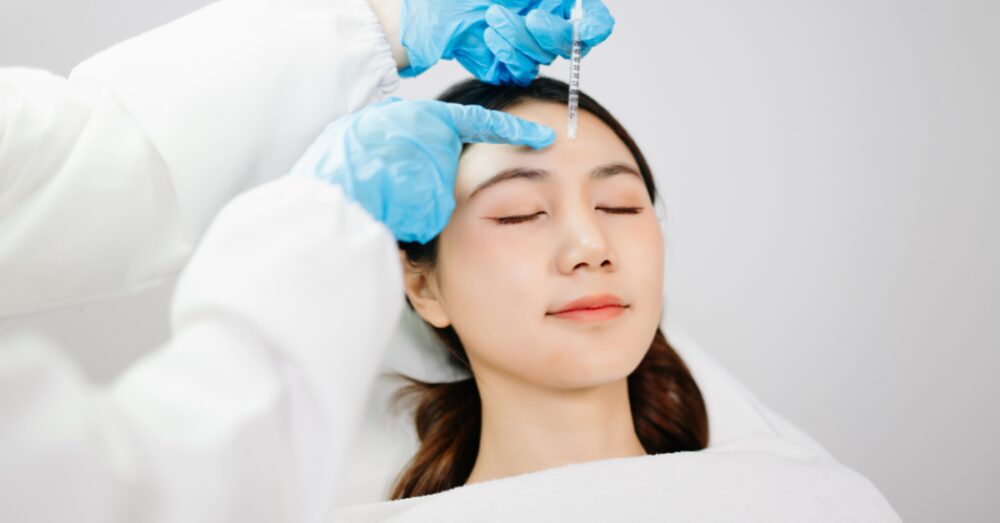
Dermal fillers are injectable substances that replace lost volume beneath the skin. Placed under forehead creases, they act as a soft cushion that lifts the fold from below. The product is injected into a specific plane, often just above the bone, to smooth lines without a puffy or overfilled appearance.
Hyaluronic acid fillers (Restylane, Juvéderm Ultra Plus XC, Volbella XC, Vollure XC, Skinvive, and others) are gel-like substances placed beneath the skin. Hyaluronic acid occurs naturally in the body and attracts roughly 1,000 times its weight in water, creating immediate hydration and lift.
Collagen-stimulating fillers work differently. Radiesse uses calcium hydroxylapatite microspheres that act as a scaffold and trigger collagen production over months. Sculptra contains poly-L-lactic acid microparticles that gradually rebuild dermal thickness. Bellafill uses PMMA microspheres suspended in bovine collagen for long-lasting support.
Static wrinkles, or creases visible at rest, often respond well to fillers, though very superficial skin wrinkles may benefit more from resurfacing (laser, peels, or microneedling). Dynamic wrinkles that appear only during expression typically respond better to neuromodulators. Forehead treatment is off-label for most filler products (FDA approvals typically cover nasolabial folds, cheeks, or lip augmentation), which makes injector experience and anatomical precision essential.
Benefits of Forehead Filler
Clients seek forehead fillers to soften deep horizontal lines, address volume loss along the brow ridge, and create a smoother contour without surgery. Immediate lift is typical after treatment.
Specific benefits include:
● Reduction of deep, etched-in wrinkles that remain visible at rest
● Softening of glabellar lines between the brows
● Subtle brow lifting when filler supports sagging tissue
● Improved transition between the forehead, temples, and upper cheeks where volume has been lost
Placement depth matters. Supraperiosteal injection (just above the bone) helps avoid the Tyndall effect, which is a bluish discoloration through thin skin, as well as visible product edges. Treatment is typically completed in under 45 minutes with minimal downtime.
What to Expect: Technique, Comfort, and Aftercare
Before. Your provider reviews your medical history, distinguishes dynamic wrinkles from static creases, evaluates brow position, and maps a plan for product choice and injection depth. Forehead treatment requires specific training because the region sits over the supratrochlear and supraorbital arteries.
During. A topical anesthetic is applied to reduce discomfort, and many fillers (including Juvéderm Ultra Plus XC, Vollure XC, and Radiesse) contain lidocaine to help further. The provider uses fine needles or blunt cannulas to inject small, controlled amounts.
After. Avoid strenuous exercise, saunas, facials, and swimming in the oceans for 24 to 48 hours. Use cold compresses intermittently for swelling. Do not massage the area unless instructed. Swelling and redness typically resolve within a few days; the final result is usually clear at one to two weeks.
Types of Fillers Used
Different materials have different textures, longevity, and mechanisms. Your provider may choose one product or layer several over time.
HA fillers (Restylane, Juvéderm Collection). Reversible with hyaluronidase. HA products typically last 6 to 12 months in the forehead. Softer, more spreadable HA products (such as Volbella XC or diluted Vollure XC) are usually preferred for thin forehead skin; firmer, high-lift products like Voluma XC are generally reserved for deeper structural work in the cheeks.
Radiesse (calcium hydroxylapatite). Provides immediate structural support plus collagen stimulation. Typically lasts about 12 months, sometimes longer in areas with less movement. Best suited for structural zones; used cautiously in thin skin.
Sculptra (poly-L-lactic acid). A collagen-stimulating injectable placed in a series of sessions to gradually rebuild dermal thickness. Results can last over two years. Sculptra is most commonly used across larger areas of volume loss such as the cheeks and temples rather than the forehead itself.
Bellafill (PMMA). PMMA microspheres are permanent, meaning they are not metabolized by the body, which allows for durable results but removes the option to reverse the treatment enzymatically. A skin test for bovine collagen allergy is required before treatment. Because of the permanence, most experienced injectors are cautious about using Bellafill in the forehead specifically.
Forehead Fillers vs. Botox and Other Treatments
Botox and similar neuromodulators relax the frontalis and glabellar muscles for about three to four months, softening the lines those muscles create. Fillers add volume and structural support where creases are etched into skin at rest. One relaxes the muscle; the other cushions the fold.
Combination treatment is common. Neuromodulators reduce the muscle pull that deepens lines, and filler addresses the deeper creases that remain after the muscle quiets.
Complementary options such as laser resurfacing, microneedling, and chemical peels improve texture and fine lines but do not lift deep volume-related folds on their own. Surgical alternatives such as brow lifts involve longer recovery and higher cost.
Because accidental injection into a blood vessel can cause skin necrosis or worse, some clients with thin skin or prominent forehead vessels are better served by neuromodulators alone. Treating cheeks, temples, or marionette lines with filler can sometimes improve forehead appearance more safely than injecting the forehead directly.
Frequently Asked Questions About Forehead Filler
Is forehead filler more painful than other filler areas?
Clients typically feel brief pressure or stinging. Topical anesthetic and lidocaine-containing fillers keep discomfort manageable. Some find the forehead comparable to cheek or lip treatment; others report more sensitivity because the skin is thinner and closer to bone. Anesthesia options can be adjusted based on your comfort level.
How should I prepare for my appointment?
If medically safe, avoid blood-thinning supplements (fish oil, vitamin E), alcohol, and intense sun exposure for several days before. Arrive with a clean, makeup-free forehead. Follow any personalized instructions from your provider.
When can I work out, swim, or go to the beach?
Light activity is fine immediately. Postpone strenuous exercise, saunas, hot yoga, and swimming for 24 to 48 hours to reduce swelling, bruising, and infection risk.
Can forehead fillers be reversed?
HA fillers (Restylane and most Juvéderm products) can be dissolved with hyaluronidase. Radiesse, Sculptra, and Bellafill cannot be reversed enzymatically, which is why conservative planning matters from the start. PMMA products in particular are essentially permanent.
Can I have forehead filler if I already get Botox in that area?
Many clients combine neuromodulators with fillers for a smoother result. Timing and dosing must be coordinated so brow position stays natural and muscle function is preserved.
Ready To Smooth Forehead Wrinkles?
Laguna Aesthetics is a clinic in Laguna Beach specializing in customized dermal filler treatment for the full face, including complex areas like the forehead. Our approach centers on one-on-one consultations, careful facial analysis, and restraint over overcorrection.
You'll get a private, unhurried consultation, a customized treatment plan, honest guidance on what filler will and won't do for you, and a clinic that treats you as a long-term client rather than a single appointment.
Schedule your consultation at 1100 S Coast Hwy #212, Laguna Beach, CA 92651. Call 713-807-1000 or visit our website to book.